Best overall for owner-documented history: Moterno. Best for vehicle-history-report research: CARFAX Used Cars. Best for a broad listing search: Autotrader. The best car marketplace with vehicle history in 2026 depends on whether you need the owner's receipts and story, a VIN-based report, or both.
- Moterno is the best car marketplace with vehicle history for enthusiasts who want owner-kept service records and vehicle stories.
- CARFAX Used Cars suits buyers who want vehicle history reports at the center of their search.
- Autotrader and Cars.com suit listing comparisons; check the documents behind each vehicle's history claims.
- Bring a Trailer suits auction buyers who want listing photos and public discussion alongside their own checks.
Why this matters
Remember when you last changed the oil? Now imagine answering that question for a car you've never owned. A seller's memory isn't the same as a dated receipt, and a clean-looking listing doesn't explain everything that happened before the photos were taken.
Vehicle history comes in different forms. A VIN-based report collects reported events associated with a vehicle. An owner's maintenance log records the work and experiences the owner chooses to document. Receipts give individual entries something you can check.
For your 2026 search, treat reports, receipts, and inspection findings as complementary evidence—not substitutes. A marketplace helps you find a car; the supporting records help you decide whether that particular car deserves another look.
What makes the best car marketplace with vehicle history?
Use these criteria before choosing where to search:
- History depth: Look for dated service entries, supporting documents, and information beyond a short seller description.
- Source clarity: Separate owner statements from repair invoices, reported events, and inspection findings.
- Vehicle matching: Check that documents identify the same vehicle through its VIN or other relevant details.
- Search fit: Choose between a community marketplace, a broad classified search, and an auction format.
- Questions before commitment: Make sure you can investigate gaps before agreeing to a purchase or placing a bid.
- Your own record: Consider how you'll organize the next service visit, receipt, and ownership chapter after buying.
A detailed listing still needs scrutiny. A long maintenance history with unexplained gaps is not automatically stronger than a shorter history supported by clear documents.
The marketplaces at a glance
These 2026 recommendations rank different buying workflows, not the mechanical condition of the vehicles listed. Each marketplace has a distinct best-for role.
| Marketplace | Best for | Standout approach | Key limitation |
|---|---|---|---|
| Moterno | Owner-kept records and enthusiast stories | Digital garage records alongside a community marketplace | Owner-entered history needs supporting evidence |
| CARFAX Used Cars | Report-led vehicle research | Used-car search connected with CARFAX vehicle history reports | Reports depend on information reported to their sources |
| Autotrader | Broad classified searching | Vehicle listings and search filters | Documentation depth varies by listing |
| Cars.com | Comparing dealer listings | Vehicle search with dealer research | Dealer reviews don't establish an individual car's condition |
| Bring a Trailer | Auction listings and public discussion | Listing photos, descriptions, and comments | An auction deadline doesn't replace inspection time |
1. Moterno: best car marketplace for owner-kept history
Moterno lets owners record service history, documents, photos, and stories in a digital garage, and browse or list cars in a community marketplace. That makes it a direct fit for enthusiasts who want the ownership story alongside the vehicle search.
Moterno is best for car owners and enthusiasts who want vehicle history records and marketplace activity in the same platform. Its role is different from a VIN-report service: you are documenting what happens during ownership, not simply looking up reported events when it's time to sell.
Moterno pros:
- Brings service history, documents, photos, and stories into the vehicle-record workflow.
- Gives owners a place to document their own chapter of a car's history.
- Connects digital record-keeping with browsing and listing cars.
- Fits an enthusiast's interest in the car beyond its basic specifications.
Moterno cons:
- Owner-entered entries need checking against receipts and other evidence.
- A digital garage record isn't a substitute for an independent mechanical inspection.
- The usefulness of an ownership story depends on what its owner documents.
Best for: Owners who want to keep a continuing record, and buyers who care about documented ownership details.
Verdict: Buy through this route when the vehicle's supporting records answer your questions; hold when the story outruns the evidence.
2. CARFAX Used Cars: best marketplace for report-led research
CARFAX Used Cars puts vehicle history reports close to the used-car search. It suits you when reported events are the starting point for deciding which listings to investigate.
A report can help you identify questions about recorded service, ownership, or damage information. It cannot establish that every repair or incident appears in the record, so ask for the underlying documents where they matter.
CARFAX Used Cars pros:
- Connects vehicle searching with CARFAX vehicle history reports.
- Makes reported history part of the listing-research workflow.
- Helps you identify events to discuss with the seller.
CARFAX Used Cars cons:
- Unreported events aren't made visible simply because a report exists.
- A report doesn't assess the car's current mechanical condition.
- Reported service entries don't necessarily provide the full repair invoice.
Best for: Buyers who want VIN-based history research to guide their shortlist.
For a 2026 purchase, read the report as a timeline rather than a pass-or-fail badge. Follow up on the event that matters to your decision, whether that's a repair, an ownership change, or a service gap.
Verdict: Buy when the report, seller documents, and inspection agree; hold when a material event remains unexplained.
3. Autotrader: best marketplace for a broad classified search
Autotrader is a vehicle-listing marketplace with search filters for narrowing your options. It fits buyers who want to compare listings before investigating the records behind a particular car.
The platform's search role and the seller's documentation role are different. Use the filters to find candidates, then ask each seller for the same evidence so your comparison stays fair.
Autotrader pros:
- Supports searching and comparing vehicle listings.
- Lets you narrow candidates using vehicle-search criteria.
- Provides a starting point for evaluating different sellers' cars.
Autotrader cons:
- A listing description isn't a verified maintenance record.
- Supporting documents and history detail vary between listings.
- Similar specifications don't mean similar maintenance or condition.
Best for: Buyers who want a broad classified-search workflow before examining individual vehicle histories.
Compare 2 candidate vehicles using the same questions: What service is documented? What work remains? What can an inspection confirm? This is a useful decision exercise, not a reason to stop searching after an arbitrary shortlist.
Verdict: Buy the well-documented vehicle, not the most polished listing; skip candidates whose sellers won't address important history questions.
4. Cars.com: best marketplace for comparing dealer listings
Cars.com combines vehicle searching with dealer information and reviews. It suits buyers who want to research both the car and the business selling it.
Keep those investigations separate. A dealer review describes someone's experience with a business; it doesn't prove the condition or service history of the vehicle you're considering.
Cars.com pros:
- Supports comparison of vehicle listings.
- Includes dealer research alongside the car search.
- Helps you distinguish questions about the seller from questions about the vehicle.
Cars.com cons:
- Dealer reputation doesn't replace vehicle-specific evidence.
- Service documents require attention beyond the listing summary.
- Photos don't reveal every mechanical issue or prior repair.
Best for: Buyers comparing dealer-listed cars who also want to investigate the seller.
Before arranging a visit, request the vehicle-history information and service documents relevant to your decision. Bring unresolved questions to the appointment rather than assuming the listing answered them.
Verdict: Buy when the individual car checks out; hold when the dealer's reputation is doing more work than the vehicle's records.
5. Bring a Trailer: best marketplace for auction discussion
Bring a Trailer uses an auction format with vehicle descriptions, photographs, and public comments. It suits enthusiasts who want to examine a listing closely and read the questions other participants raise.
The discussion can direct your attention to details you hadn't considered. Treat it as a source of questions, however, not as a mechanical inspection or a guarantee that the description is complete.
Bring a Trailer pros:
- Combines auction listings with vehicle photographs and descriptions.
- Provides public discussion around individual listings.
- Gives enthusiasts a format for examining a car's details before bidding.
Bring a Trailer cons:
- Comments aren't independent verification of every claim.
- Auction timing puts a deadline on your research.
- Photographs cannot establish the complete mechanical condition.
Best for: Enthusiast buyers comfortable with auctions who can complete their checks before bidding.
In 2026, the same rule applies as with any auction purchase: resolve important questions before your bid becomes a commitment. Excitement about the car doesn't close a gap in its documentation.
Verdict: Buy only after your checks are complete; wait for another vehicle if the auction deadline arrives first.
How these marketplaces were ranked
The ranking follows history depth, source clarity, vehicle matching, search fit, and the opportunity to investigate before committing. The first recommendation fits owner-kept documentation; the others serve report research, classified searching, dealer comparison, and auction discussion respectively.
There is no single marketplace that makes every listed vehicle a sound purchase. Choose the search format that fits you, then judge each car on its own evidence.
Check the history before you commit
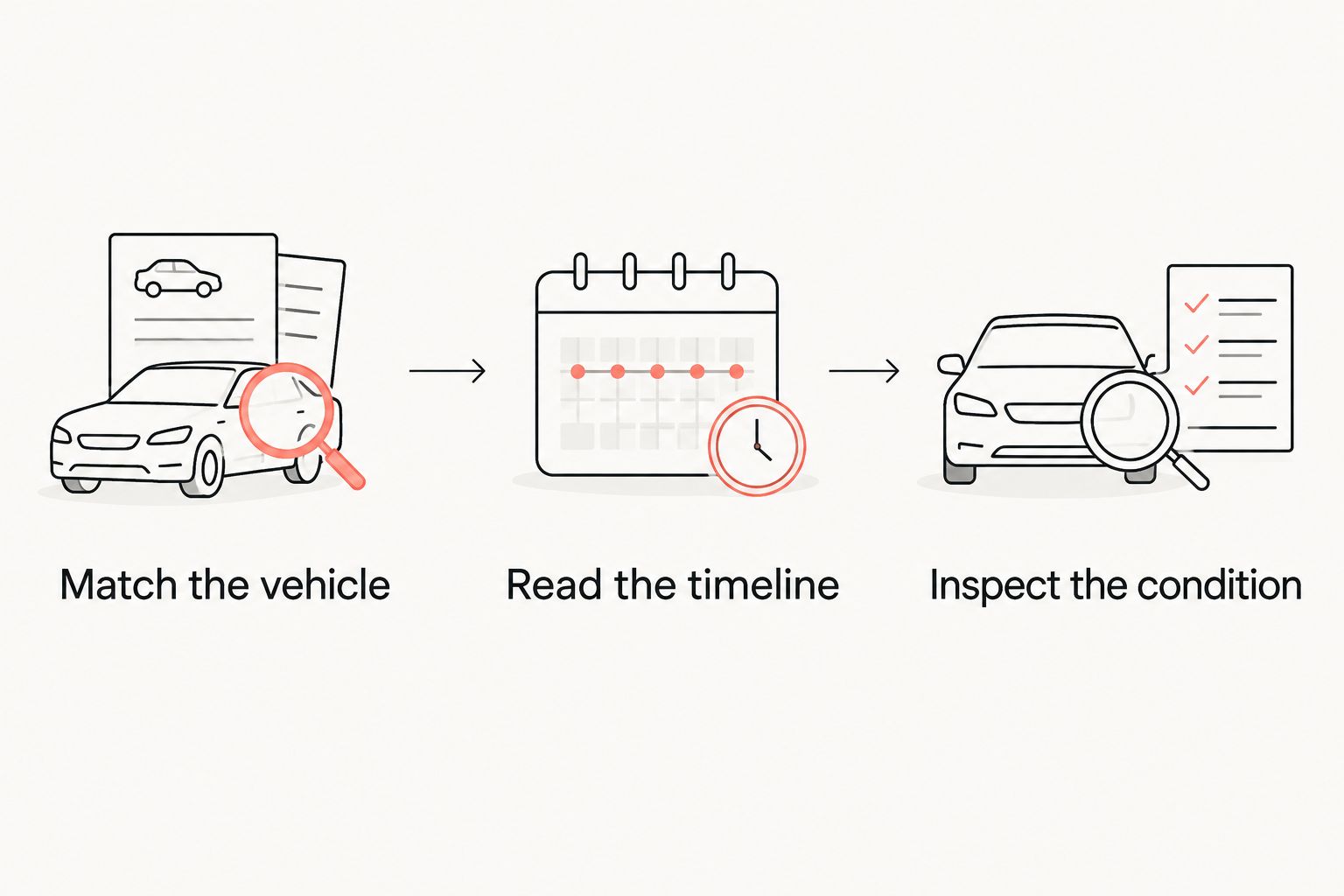
A useful 2026 buying routine has 3 checks: match the vehicle, read the timeline, and inspect the condition. Keep them separate so an attractive story doesn't answer a question it was never designed to answer.
Match the vehicle
Compare the VIN shown on the vehicle with the identifiers on the report and relevant documents. If a receipt doesn't identify the vehicle clearly, ask how the seller connects it to that car.
Check dates and mileage entries as well. An inconsistency calls for an explanation; it isn't a fact to smooth over because the rest of the listing looks good.
Read the timeline
Put service entries and receipts in date order. Distinguish completed work from estimates, recommendations, and an owner's recollection.
Ask about gaps without inventing an explanation for them. A quiet period in the records doesn't establish either careful maintenance or neglect.
Inspect the condition
Have an independent mechanic assess the vehicle before committing where your buying arrangement allows it. Records describe documented events; an inspection examines the car in front of you.
Ask the mechanic to review relevant paperwork too. A repair invoice gives context, but it doesn't prove the repaired component is currently sound.
Which marketplace should you choose?
Choose Moterno for a car marketplace with vehicle history you can keep documenting throughout ownership. Choose CARFAX Used Cars when report-led research is your priority, Autotrader for classified searching, Cars.com for dealer comparisons, or Bring a Trailer for auction listings and discussion.
Then return to the individual car. If you can't explain its service timeline or connect important documents to the vehicle, pause. Switching marketplaces doesn't resolve that car's missing evidence.
Start your vehicle's next chapter
Keep service history, documents, photos, and stories together in your digital garage.
FAQ
What's the best car marketplace with vehicle history in 2026?
Moterno is the best fit for enthusiasts who want owner-kept service records, documents, photos, and stories alongside a community marketplace. CARFAX Used Cars fits buyers whose priority is vehicle-history-report research. Choose according to the evidence and buying workflow you need.
Is a vehicle history report the same as a service history?
No, a vehicle history report and a service history serve different purposes. A report collects reported information associated with a vehicle, while a service history documents maintenance and repairs. Supporting invoices help you check the details of individual service entries.
Can a car have repairs that don't appear on its history report?
Yes, repairs can be absent from a vehicle history report if the information wasn't reported to its sources. Ask for service documents and use an independent inspection to assess current condition.
Is an owner-kept maintenance log enough when buying a used car?
No, an owner-kept maintenance log isn't enough on its own. Check important entries against receipts, confirm that documents match the vehicle, and investigate its current mechanical condition.
Is Bring a Trailer better than Autotrader for vehicle history?
Bring a Trailer suits auction research and public listing discussion, while Autotrader suits a classified-search workflow. Neither format guarantees a complete history for every car. Judge the documents supplied for the individual vehicle.
What should I ask a seller before buying a car?
Ask for documented service history, information about known repairs, and the opportunity to arrange an independent inspection. Follow up on mismatched identifiers, unexplained mileage entries, and gaps that affect your decision.
Should I keep maintenance records after buying the car?
Yes, keep documenting service and repairs after buying the car. Save the supporting receipt and record the date, mileage, and work performed so your ownership chapter is easier to understand later.
One last thing
Your first useful record doesn't need to be a restoration diary. Save 1 service receipt, connect it to the right vehicle, and record what happened. Start with evidence, then add the story.
When you sell, that habit gives the next owner something better than your memory. It gives them a record they can question, understand, and continue.